
Bitcoin in a Liberal Majority Government

Committee composition will change shortly under a Liberal majority. That makes effective government outreach more important than ever, and it means working with critics is just as important as working with government leaders.
A majority government changes the math in Ottawa, but it does not remove the need for persuasion. The real work still happens in caucus, in committee, and in the conversations that shape a file before it ever reaches the House.
The opportunity for the Bitcoin sector is not to ask Parliament to understand Bitcoin in the abstract. It is to connect Bitcoin to the problems Parliament is already trying to solve: competitiveness, investment, energy development, consumer protection, and economic sovereignty.
Budget 2025 gave the stablecoin industry something it had been asking for: a clearer path to federal regulation. That matters for Bitcoin too, because it shows how a digital-asset issue can move when it is attached to a policy priority government already understands. Stablecoins connected themselves to competitiveness, payments, consumer protection, and financial-sector innovation. Bitcoin will need to do the same.
In practical terms, that means every political ask has to tie back to the government’s core priorities. The Prime Minister’s 2025 mandate letter sets out seven priorities that are driving the work of government. If a Bitcoin proposal cannot be connected to one of those priorities, it will be much harder to move. The better path is to frame Bitcoin around the issues already on the table: building the strongest economy in the G7, strengthening Canadian sovereignty, lowering costs, attracting investment, improving productivity, and making government more focused on results.
The strategic opening
A majority government can move faster than a minority government, but it still has to manage cabinet, caucus, committees, regional sensitivities, and public opinion. That matters for anyone trying to put Bitcoin into the serious policy conversation.
The risk is that Bitcoin is still too often filtered through a narrow frame: speculation, volatility, fraud, or electricity use. The opportunity is that Parliament is also looking for answers on productivity, capital investment, energy growth, and financial innovation.
That is where the Canadian Bitcoin Consortium is creating value. The strongest message is not “Bitcoin deserves attention.” The strongest message is “Bitcoin belongs in the policy conversations Parliament is already having.”
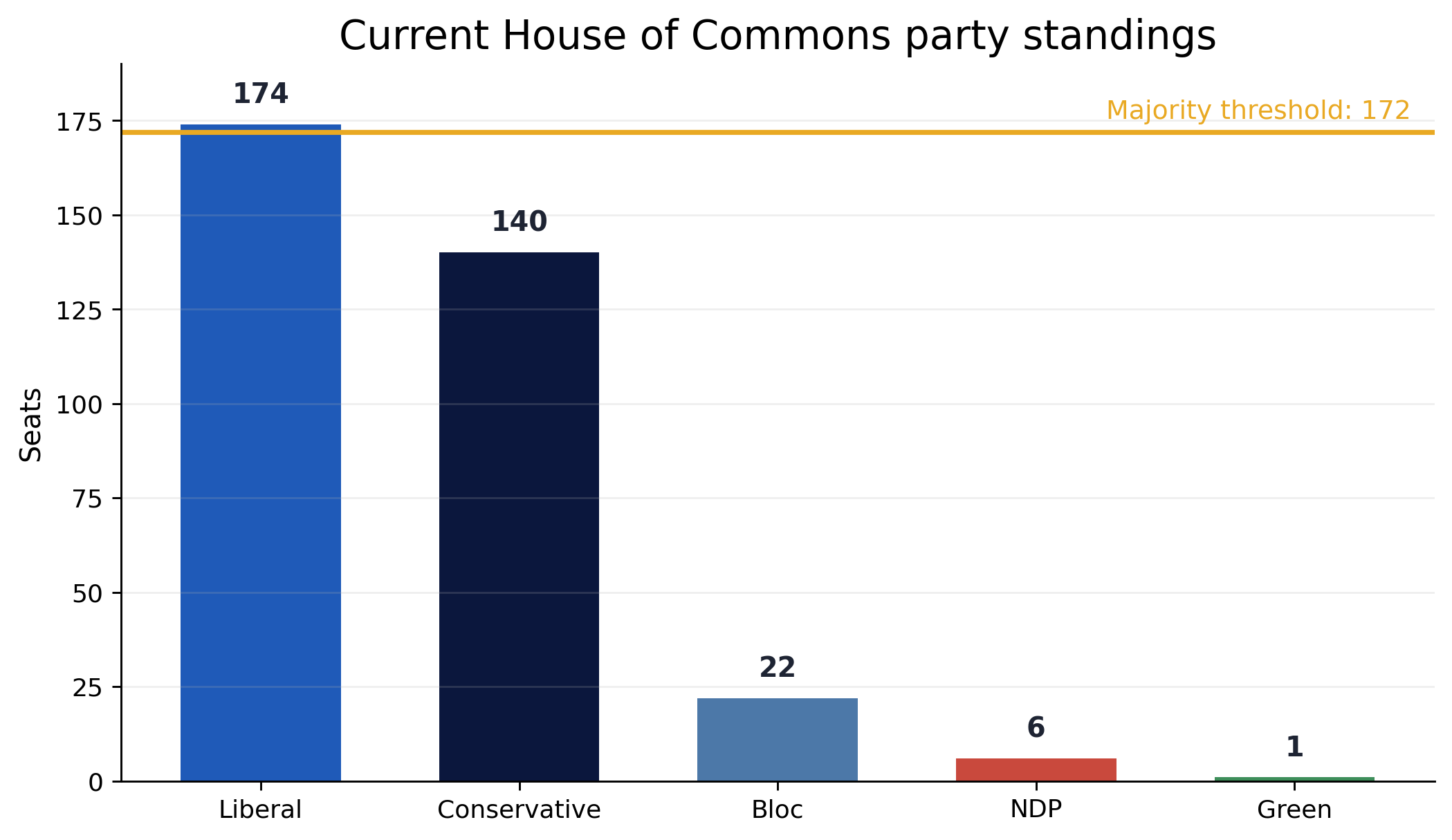
A Liberal majority changes the path to passing legislation, but committees and critics still matter because they shape debate before ideas become decisions.
The most effective GR work in this Parliament will be practical, disciplined, and rooted in policy outcomes rather than tech-first advocacy.
Why critics still matter
One mistake stakeholders make in a majority Parliament is assuming that critics no longer matter. They do. In fact, they often matter more than outsiders expect.
Critics are where policy ideas get stress-tested. They ask what could go wrong, how an issue will play publicly, what a minister will have to defend, and what vulnerabilities could emerge in committee or Question Period.
For a sector like Bitcoin, that makes critics indispensable. If critics understand the file, the debate gets smarter. If they do not, the discussion can harden around fear, misunderstanding, or stale assumptions.
That is why engagement with critics should be treated as part of policy development, not as a courtesy call.
The point is not to turn every critic into an ally. The point is to make sure the debate is informed, practical, and grounded in evidence.
Start with problems, not technology
The best first meeting is not a seminar on wallets or proof-of-work. It is a plain-language conversation about a problem Parliament already cares about: tax clarity, consumer protection, energy opportunity, investment certainty, or Canadian competitiveness.
Canada has an opportunity to become a more competitive jurisdiction for responsible Bitcoin investment, energy innovation, and financial choice. To get there, policymakers need clear rules, practical tax treatment, credible consumer protection, and a better understanding of how Bitcoin connects to jobs, energy, and growth.
The real win is getting into the briefing binder
Most people assume government relations is about landing the big meeting with the minister. That meeting matters, but in Ottawa it often arrives late in the process.
The quieter win is getting your framing into the briefing binder before the issue becomes public. That means the argument is clear enough for staff to repeat, public servants to place inside an existing policy frame, caucus members to understand quickly, and committee MPs to test seriously.
For Bitcoin, the goal is not simply to persuade someone that the technology is good. The goal is to make the file easy to carry inside government: tax treatment, competitiveness, consumer protection, energy infrastructure, and capital formation. A strong GR strategy does not end when the meeting ends. It leaves people with language they can use after you leave the room.
What a successful GR strategy looks like
Define the policy problem in plain language. Lead with a policy problem that Parliament recognizes: predictable rules, investment confidence, consumer clarity, energy opportunity, or competitiveness.
Map the real decision-makers. The real audience includes ministers, political staff, caucus voices, public servants, committee members, critics, and credible third-party validators.
Use committees as a path to legitimacy. Committees slow the debate down, hear witnesses, and create a stronger policy record than the daily political cycle.
Bring evidence, not slogans. Short briefing notes, public data, regional examples, and practical case studies travel farther than broad claims or ideology.
Make the first ask realistic. The first ask should unlock the next conversation: a briefing, a roundtable, a written submission, or a committee appearance.
The map of influence
In Ottawa, not every conversation carries the same weight. A strong GR strategy starts by knowing which doors to knock on first, where the issue can mature, and which critics will pressure-test the file.
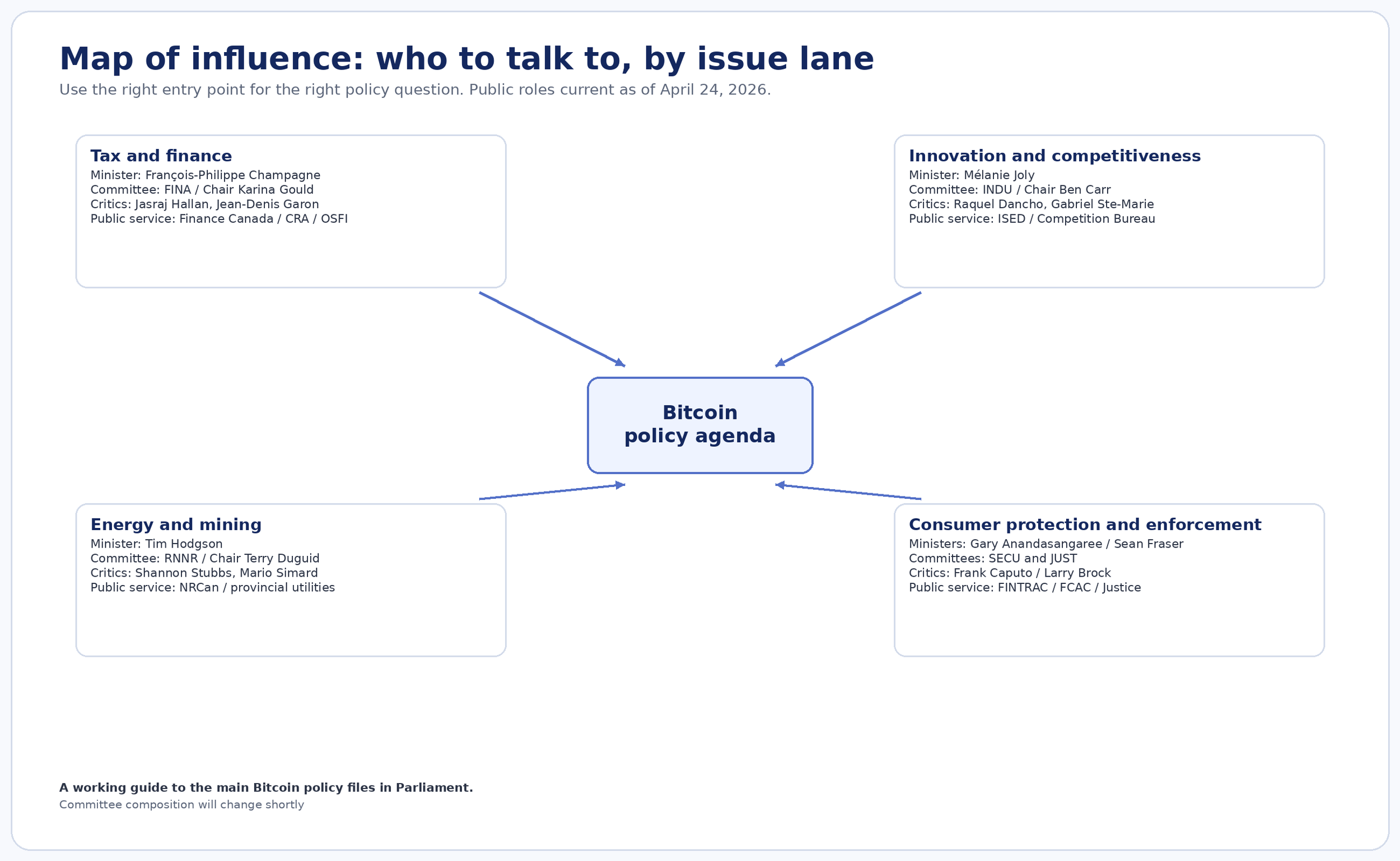
A working map of the main Bitcoin policy files in Parliament.Committee composition will change shortly
Who to talk to, and why
The names below are not exhaustive, but they are the most useful public-facing entry points for a serious first wave of engagement.
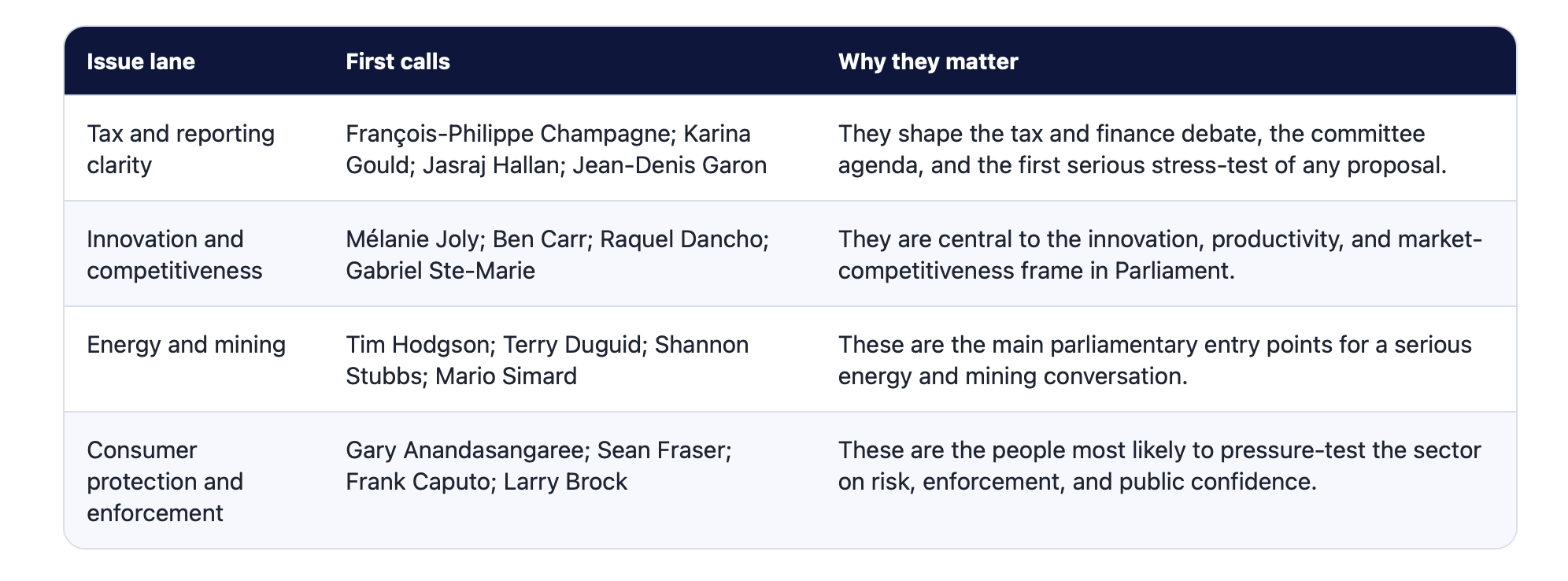
The practical lesson is simple: do not run one generic Bitcoin message to everyone. Tailor the message to the lane. Finance hears tax clarity. Industry hears competitiveness. Natural Resources hears flexible demand and investment. Justice and Public Safety hear consumer protection and enforcement.
How to get expert testimony into committee
Committee testimony is one of the fastest ways to move a file from general interest to credible parliamentary evidence. For Consortium clients, it is the bridge between advocacy and a serious policy record.
A practical five-step pathway:
Define the issue tightly so it fits a committee mandate: tax treatment, consumer protection, energy and mining, competitiveness, or regulatory alignment.
Match the issue to the right committee. In most cases, the first lanes are Finance, Industry and Technology, Natural Resources, Public Safety, or Justice.
Build a witness list that balances industry voices with third-party validators such as tax lawyers, energy economists, rural leaders, academics, or fraud-prevention specialists.
Prepare a disciplined evidence package: a short briefing note, a handful of strong data points, a question-and-answer sheet, and one concrete ask.
Follow up after testimony with a brief, clarifications, and suggested next steps so the appearance turns into momentum.
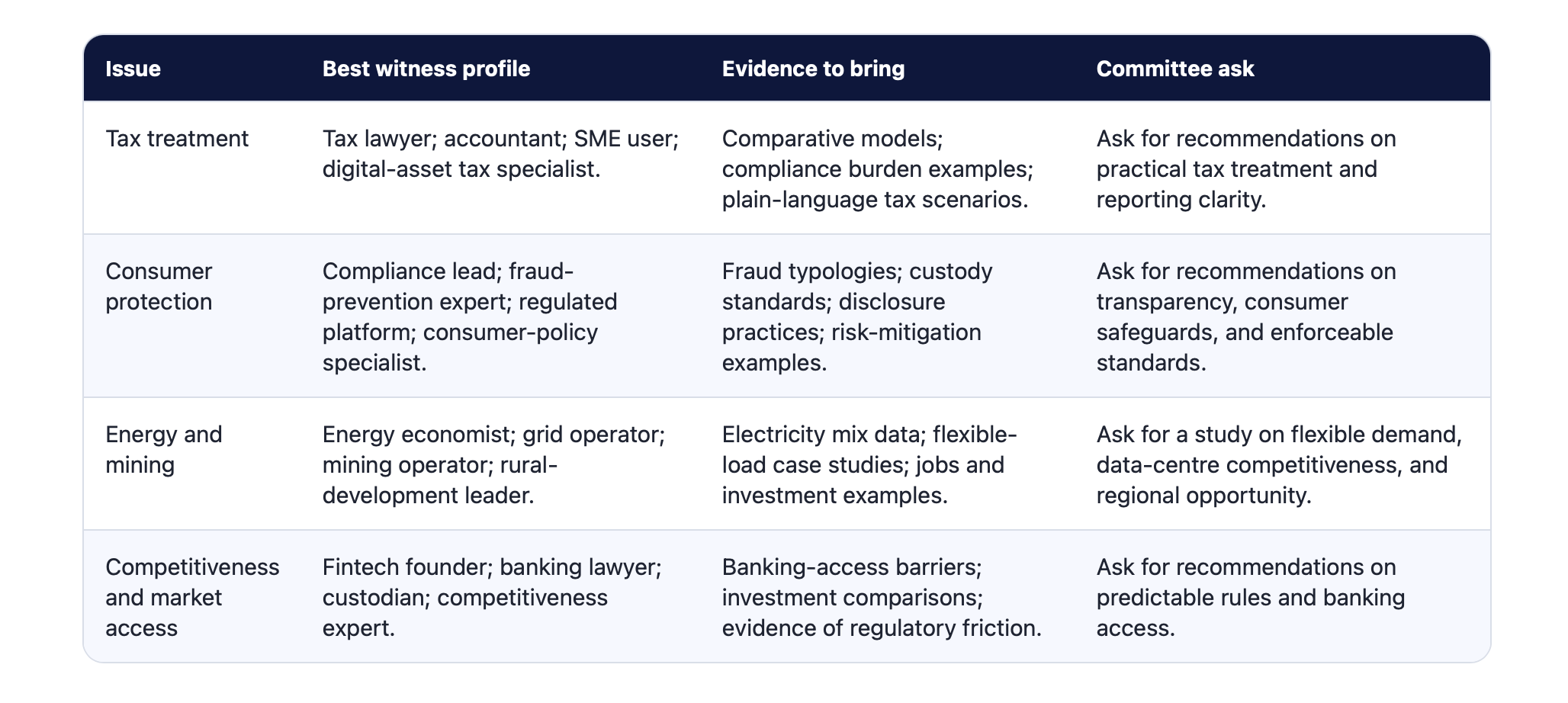
The likely starting points are Finance (FINA), Industry and Technology (INDU), Natural Resources (RNNR), Public Safety (SECU), and Justice (JUST).
Committee composition will change shortly
Evidence that gives the issue policy weight
Bitcoin is no longer fringe, but it is not yet fully mainstream. That is exactly why it is a serious policy topic: visible enough to matter, but early enough that good policy can still shape the market.
For advocates, the implication is straightforward: lead with credible, bounded asks. Parliament does not need to “solve Bitcoin.” It needs to decide where practical policy clarity would reduce friction, protect consumers, and support innovation.
The energy opportunity
Energy is one of the strongest places for the sector to add nuance. Too often, the Bitcoin mining conversation begins and ends with electricity use. That is too shallow for a country like Canada.
A better conversation focuses on grid management, flexible demand, underused energy, rural investment, and how Canada’s electricity mix compares internationally.
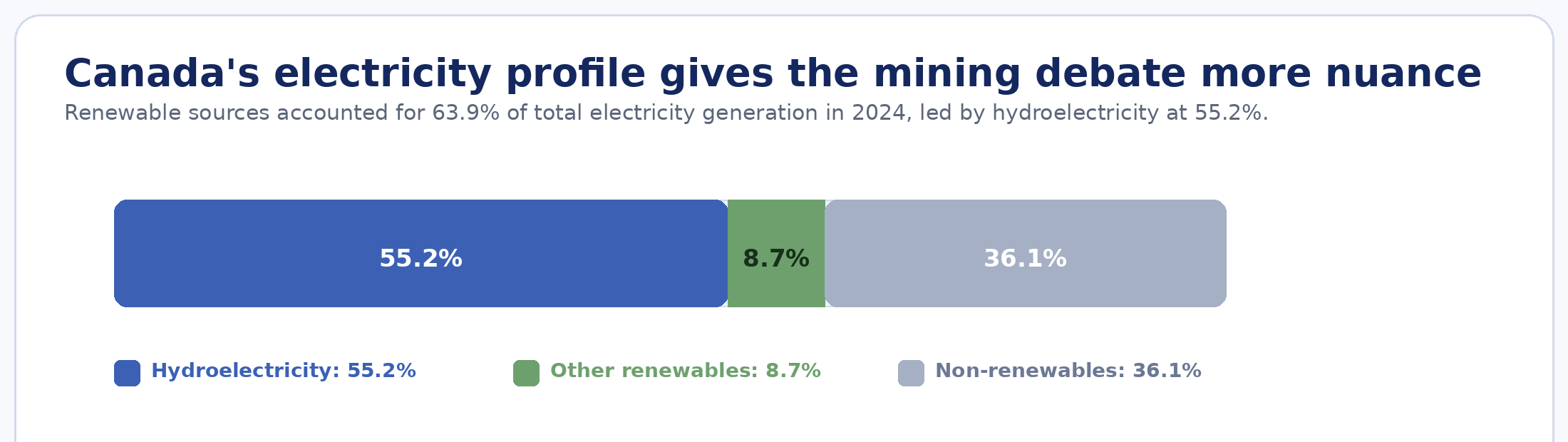
Canada’s electricity profile gives policymakers a stronger starting point for a serious mining and energy discussion.
Statistics Canada reported that renewable sources accounted for 63.9% of Canada’s electricity production in 2024, with hydroelectricity alone accounting for 55.2%. That does not mean every mining project is good policy. It does mean the conversation should be more sophisticated.
The better questions are where the power comes from, whether the load is flexible, whether the project supports regional development, and whether the policy framework protects consumers and communities while attracting investment.
Conclusion: the window is open, but the case has to be practical
A Liberal majority creates a different kind of opportunity for the Bitcoin sector. It may make Parliament more predictable, but it does not make persuasion automatic.
The sector’s strongest path is not to ask government to care about Bitcoin on Bitcoin’s terms. It is to connect Bitcoin to the priorities already driving the federal agenda: competitiveness, investment, energy, consumer protection, productivity, and Canadian sovereignty.
That means showing up with evidence, speaking in plain language, engaging critics seriously, and making the file easy for policymakers to carry inside government after the meeting ends.
The stablecoin conversation has already shown that digital-asset policy can move when it is tied to a government priority. Bitcoin now needs to make its own case with the same discipline.
For the Canadian Bitcoin Consortium, that is the opportunity: helping turn a technical conversation into a serious policy conversation.
