

When we talk about Bitcoin's future in Canada, the conversation often focuses on what government hasn't done. The regulations that still need work, the barriers facing Canadian businesses, and the opportunities we risk losing to other countries.
Those conversations are important. But so is recognizing progress when it happens.
On November 5, the federal government introduced Budget 2026, Masters of Our Destiny, with a focus on strengthening Canada's economic independence, attracting investment, improving productivity, and building the infrastructure needed for long-term growth. For Canada's Bitcoin and broader digital asset industry, there are several encouraging developments worth recognizing.
Budget 2026 is not a Bitcoin-specific budget. It doesn't introduce a national Bitcoin strategy or resolve every regulatory challenge facing the sector. But it does take meaningful steps toward creating the conditions that innovative Canadian businesses need to succeed. Importantly, it also advances Canada's emerging regulatory framework for stablecoins, recognizing their potential to support faster payments, financial competition, and innovation.
And that deserves attention.
Making Canada a Better Place to Invest
One of the most significant announcements in Budget 2026 is the Productivity Mega Deduction, a permanent measure designed to make business investment more attractive in Canada.
Under the new rules, businesses can immediately deduct the full cost of eligible capital investments acquired on or after September 15, 2026. Approximately two-thirds of capital assets are expected to qualify, compared with roughly 15% previously. The government estimates that these changes will reduce Canada's marginal effective tax rate on new business investment from 13% to 6.4%, positioning Canada as one of the most competitive destinations for new investment in the G7.
Canada™s investment tax advantage
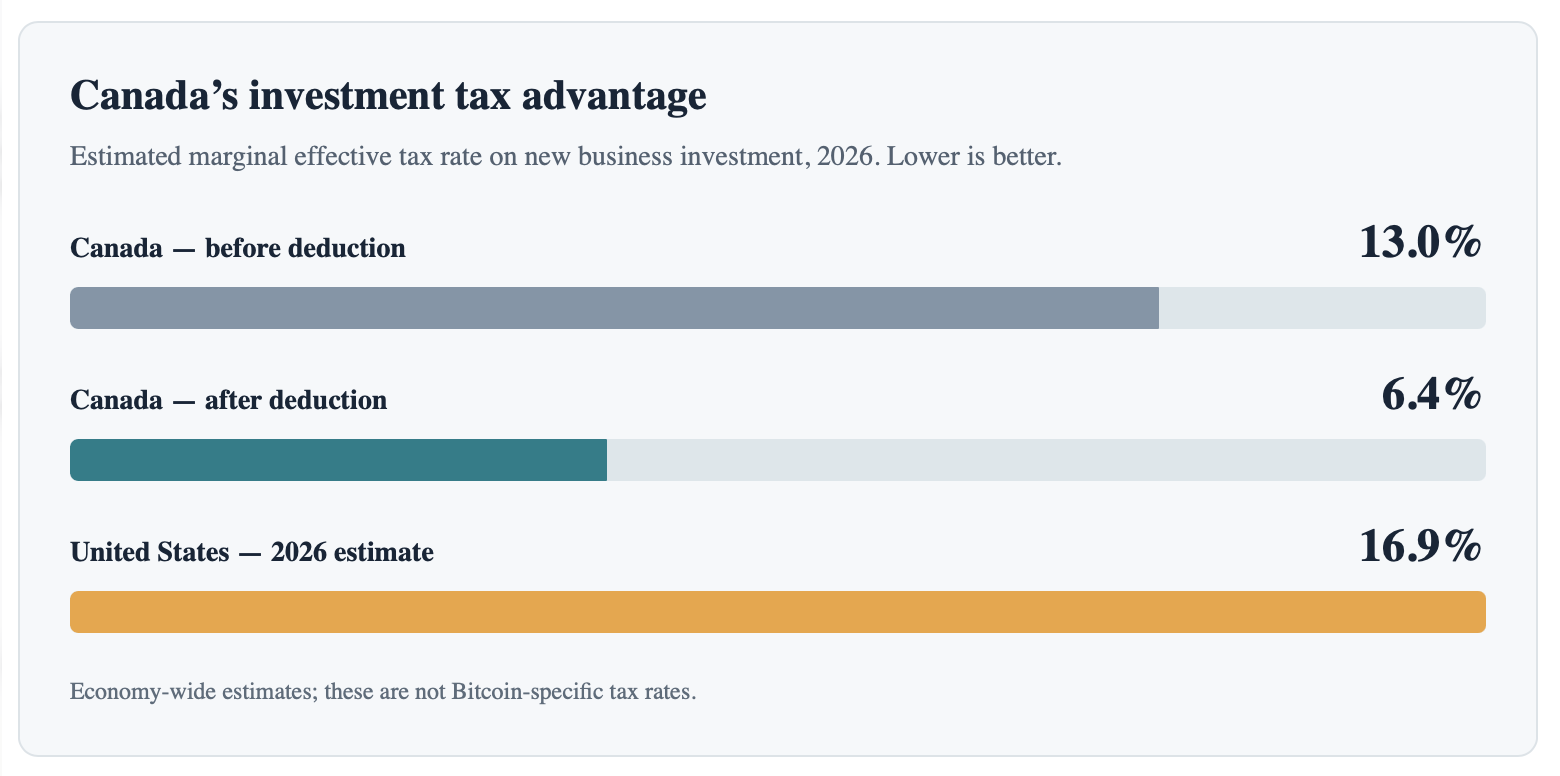
Economy-wide estimates; these are not Bitcoin-specific tax rates.
Estimated marginal effective tax rate on new business investment (2026)
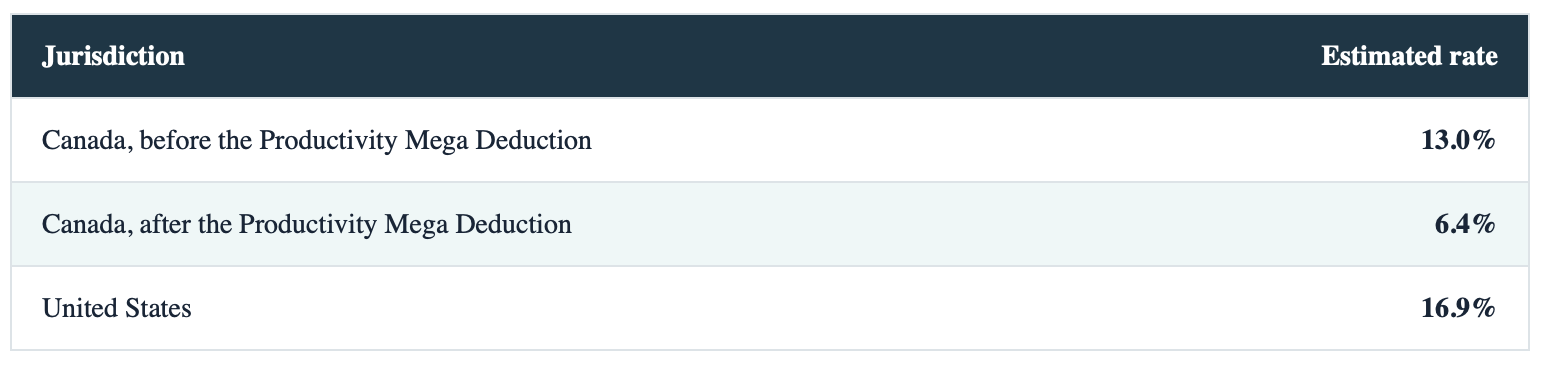
For an industry that relies heavily on technological infrastructure, this is an important development.
Bitcoin mining and digital infrastructure businesses require significant upfront investment in equipment, computing infrastructure, electrical systems, and technology. Making eligible investments more tax-efficient could improve the business case for expanding operations in Canada.
While the precise treatment of Bitcoin mining equipment will depend on applicable tax rules and eligibility requirements, the broader direction is encouraging. Canada is recognizing that attracting capital requires more than promoting innovation. It requires creating an environment where businesses can afford to build. For Canadian Bitcoin companies competing with jurisdictions around the world, that distinction matters.
Supporting the Next Generation of Canadian Innovators

Budget 2026 also introduces measures designed to help Canadian entrepreneurs attract investment, commercialize technologies, and build successful companies at home.
The new Canada Growth Incentive includes a proposed capital gains exemption of up to $15 million on qualifying investments in Canadian businesses, alongside expanded opportunities to defer capital gains taxes when proceeds are reinvested in eligible Canadian small businesses.
This is not a capital gains exemption for Bitcoin holdings. Rather, it is an incentive intended to encourage investment in Canadian companies. That difference is important, but so is the opportunity.
Canada has a growing ecosystem of Bitcoin entrepreneurs developing financial technologies, payment solutions, cybersecurity tools, and digital infrastructure. These businesses need access to capital, and investors need reasons to support their growth. The budget also provides $930 million to expand the Scientific Research and Experimental Development (SR&ED) program's commercialization support, helping Canadian businesses bring new technologies to market.
Not every Bitcoin-related business or project will qualify. But companies undertaking eligible research, development, and commercialization activities could benefit. These measures recognize something the technology sector has been saying for years: Canada doesn't simply need to produce innovative ideas. We need to create the conditions for those ideas to become successful Canadian businesses.
Canada's Energy Advantage Is Becoming a National Priority
Perhaps the most interesting development for Canada's Bitcoin mining sector is the government's renewed commitment to energy infrastructure. Budget 2026 commits more than $50 billion through the National Electricity Strategy, with the objective of doubling Canada's electricity system by 2050.
The strategy focuses on expanding generation and transmission capacity, strengthening domestic supply chains, improving affordability, and ensuring Canada has sufficient electricity to support a growing, increasingly technology-driven economy.
This is particularly relevant to Bitcoin mining.
Canada already possesses some of the world's strongest advantages in energy production. Provinces such as Alberta, Quebec, Manitoba, and Saskatchewan offer opportunities to connect energy development with emerging digital industries. Bitcoin mining has a unique characteristic that deserves greater recognition in these discussions: flexibility.
Unlike many traditional industrial facilities, Bitcoin mining operations can adjust electricity consumption rapidly in response to changing market conditions, grid requirements, or available supply. When properly integrated into electricity markets, flexible mining operations can potentially help monetize otherwise underutilized energy, support demand-response arrangements, and create additional revenue opportunities for energy producers. These benefits depend on thoughtful project design, appropriate market rules, and protecting the interests of other electricity users.
Budget 2026 does not specifically identify Bitcoin mining as part of its energy strategy. Nevertheless, its emphasis on expanding Canada's energy capacity creates an opportunity for the industry to demonstrate how mining can contribute to broader national objectives. The government's recognition that abundant, affordable electricity is essential to Canada's future competitiveness is a welcome foundation for that conversation.
Advancing Canada's Stablecoin Framework

Another important development in Budget 2026 is the government's continued progress toward a clearer regulatory framework for stablecoins. Stablecoins, which are digital assets designed to maintain a stable value relative to a currency such as the Canadian or U.S. dollar, are increasingly being used to facilitate payments and financial settlement.
While Bitcoin and stablecoins serve different purposes, both are part of a growing digital asset ecosystem that stands to benefit from clearer rules and more modern financial infrastructure. Building on the Stablecoin Act, introduced through Budget 2025 and enacted in 2026, Budget 2026 proposes additional measures to strengthen regulatory clarity and consumer protections. These include requiring federally regulated financial institutions to issue stablecoins through subsidiaries subject to the Stablecoin Act, extending the framework to certain foreign issuers, and examining further protections for consumers in the event of an issuer or custodian becoming insolvent.
The government has also acknowledged the potential for stablecoins to facilitate faster and more efficient transactions, increase competition, and provide Canadians with additional payment options.
This is a welcome development.
For Canadian businesses, regulatory uncertainty has long been an obstacle to developing and adopting digital asset technologies. Establishing clearer expectations for issuers and market participants can help support responsible innovation while giving consumers greater confidence.
The private sector is already demonstrating what this future could look like. In May 2026, Canadian digital asset infrastructure provider Tetra Digital Group launched CADD, a Canadian-dollar-backed stablecoin issued by Tetra Trust Company, a provincially regulated financial institution. CADD is designed to facilitate Canadian-dollar transactions on blockchain networks and is backed by Canadian-dollar reserves.
The initiative is supported by prominent Canadian financial and technology companies, including Wealthsimple, National Bank of Canada, ATB Financial, Shakepay, Purpose Unlimited, and Shopify. Wealthsimple has played a particularly active role in demonstrating the technology's potential. It participated in testing transfers of CADD with National Bank and has entered into commercial arrangements with Tetra and CAD Digital relating to CADD's distribution and support.
Separately, Wealthsimple and Visa Canada successfully conducted a stablecoin settlement pilot using USDC, demonstrating how blockchain-based infrastructure can enable settlement outside traditional banking hours. These developments are significant because they show that stablecoins are moving beyond theoretical discussions and into practical applications involving established Canadian financial institutions.
The technology is still developing, and broad adoption will require continued collaboration among financial institutions, regulators, and technology providers. But Canada is increasingly demonstrating that it can be a participant in the future of digital payments rather than simply observing developments elsewhere.
Budget 2026's continued support for regulatory clarity is an important part of that progress.
Opening the Door to Greater Financial Competition
Beyond stablecoins, Budget 2026 places a welcome emphasis on modernizing Canada's financial system.
The government proposes measures to support the growth of challenger banks and credit unions, advance payments modernization, expand data portability, and strengthen competition in financial services.
For Canadian Bitcoin businesses, access to reliable banking services remains one of the industry's most persistent challenges. Even companies operating within established regulatory requirements can encounter difficulties obtaining and maintaining banking relationships. A more competitive financial system could help create additional opportunities for financial technology companies and emerging digital asset businesses.
The budget also highlights efforts to reduce internal trade barriers, including a new financial services chapter under the Canadian Free Trade Agreement and steps toward a more integrated Canadian capital market. These are constructive developments for businesses that want to expand nationally without navigating unnecessary fragmentation.
Of course, greater competition does not automatically guarantee banking access for Bitcoin companies. That will require continued engagement among financial institutions, regulators, government, and industry.
Still, the direction is promising.
When financial services become more competitive, businesses have greater opportunities to innovate, and Canadians benefit from more choice.
Building Trust While Supporting Responsible Innovation

Budget 2026 also reinforces the government's commitment to tackling financial fraud, money laundering, and organized crime.
It highlights the establishment of a new Financial Crimes Agency, along with measures under Bill S-8 addressing the criminal abuse of money services businesses and cryptocurrency ATMs.
For the Bitcoin industry, this remains an important area for constructive engagement. Canadians deserve protection from fraud, and legitimate businesses benefit from public confidence in the financial system.
At the same time, effective regulation should distinguish between criminal activity and businesses operating responsibly within Canada's regulatory framework. The Canadian Bitcoin industry has an important role to play in helping policymakers develop measures that protect consumers without unnecessarily restricting financial innovation or access to legitimate services.
Strong consumer protections and a competitive Bitcoin industry do not have to be competing objectives. With meaningful industry engagement, Canada can pursue both.
The Work Ahead
Budget 2026 represents progress, but there is still work to do.
Canada needs greater clarity around Bitcoin's regulatory and tax treatment, improved access to banking services for compliant digital asset businesses, and policies that recognize the economic contribution of Bitcoin mining and its potential role in energy development.
We also need continued collaboration between government and industry to ensure that consumer protection measures are proportionate, practical, and informed by how the technology actually works. These are not unreasonable objectives. They are the foundations of a competitive and responsible industry.
The encouraging development in Budget 2026 is that several of the government's broader economic priorities now align with what the Bitcoin sector has long advocated: greater investment, stronger infrastructure, innovation, competition, and economic independence. The continued advancement of Canada's stablecoin framework is particularly encouraging, showing a growing willingness to engage with emerging financial technologies and the businesses developing them.
The challenge for our industry is to demonstrate how Bitcoin can contribute to those same national priorities.
A Positive Step in the Right Direction
Canada has an opportunity to become a global leader in Bitcoin infrastructure, energy innovation, and financial technology.
We have abundant energy resources, talented entrepreneurs, sophisticated financial institutions, and the stability that international investors value. Budget 2026 takes several meaningful steps toward strengthening those advantages.
The investment incentives are significant. The commitment to expanding electricity infrastructure is ambitious. The continued development of a stablecoin regulatory framework is encouraging. And the emphasis on financial-sector competition creates opportunities for new conversations about how Canadians access and use financial services. None of this means the work is finished.
But progress doesn't always arrive as a Bitcoin-specific announcement. Sometimes it comes through the broader economic policies that make innovation, investment, and growth possible.
Budget 2026 is a constructive step forward. The next opportunity is ensuring that Canada's Bitcoin and digital asset industries have a meaningful place in the economy we are building.
